
Open data.
Transparent process.
Open satellite and multibeam data, transparent processing, and IHO-standard evaluation — the real stack behind NAVBathy, end to end.
Foundations
Built on open data and a straightforward web + processing architecture — no black boxes.
STAC Scene Discovery
Sentinel-2 scenes are located via SpatioTemporal Asset Catalog (STAC) search — AWS Earth Search as the primary source with Microsoft Planetary Computer as fallback.
Web App + Processing Tier
A Next.js 15 web application talks to a separate FastAPI processing tier that runs the imagery, bathymetry, and multibeam pipelines as asynchronous jobs.
Open Data, Not Proprietary Feeds
Built entirely on public data: ESA Sentinel-2 optical imagery, NASA ICESat-2 lidar, and Copernicus Marine and elevation services.
Satellite-Derived Bathymetry
Depth estimated from raw Sentinel-2 optical bands, calibrated against real lidar returns
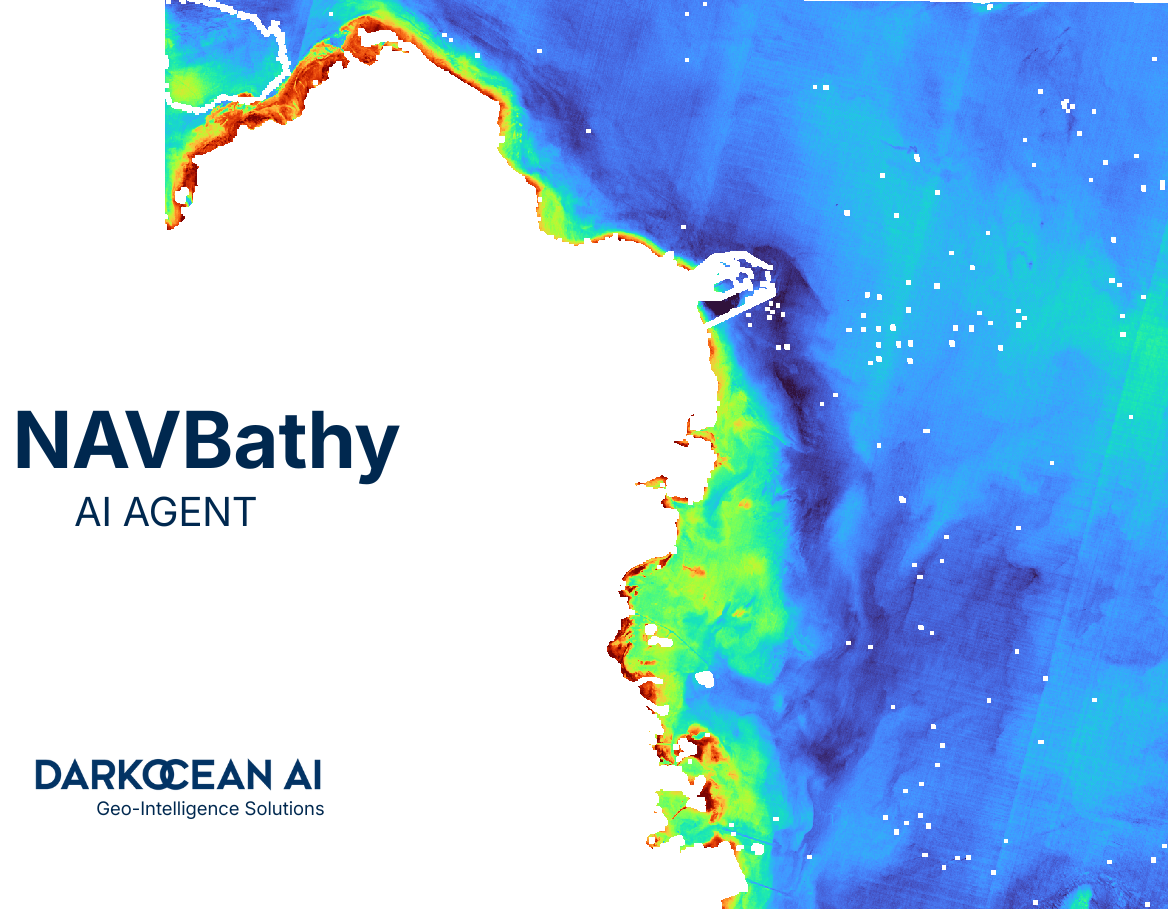
Log-ratio and multiband algorithms run directly on raw Sentinel-2 band values, with an NDWI water mask separating sea from land, to estimate relative depth across the 0–15 m range.
That relative depth is converted to absolute depth using ICESat-2 ATL24 lidar ground-truth, retrieved per scene from NASA’s ATL24 archive and fit with a robust Theil-Sen regression — no single headline accuracy number, because performance is calibrated scene by scene.
Multibeam & S-44 Compliance
Explainable, human-in-the-loop cleaning built toward an IHO-standard survey deliverable
Multibeam data (.kmall, .s7k, or GSF) is ingested with MB-System, then cleaned with an XGBoost classifier whose flags are explained sounding-by-sounding with SHAP. A surveyor reviews every decision — possible real features are never auto-rejected, only flagged VERIFY and retained.
Cleaned soundings are gridded with CUBE and evaluated against IHO S-44 Ed 6.1.0 uncertainty limits. The resulting compliance certificate always requires human sign-off before it's final, and the surface exports as BAG 1.6.2.
Terrain, Forecasting & Standards
What sits above and around the bathymetry: land context, sea-state forecasts, and the rules we hold ourselves to
NAVTopo
Copernicus GLO-30 elevation data rendered as hillshade with hypsometric tint and adaptive contour lines, giving coastal terrain context around the bathymetry.
Ocean Forecasting
Wave, current, and wind forecasts from Copernicus Marine (CMEMS) feed an operability view, so survey windows can be assessed against expected sea state.
Fixed Depth Rendering
Depth is always rendered on a fixed, absolute colour scale (Turbo) — colour is the only layer that carries quantitative depth. Hillshade and relief add visual texture but never encode depth themselves.
IHO S-44 Ed 6.1.0
Vertical uncertainty is evaluated against TVU_max(d) = √(a² + (b·d)²) at 95% confidence, using the order-specific constants defined in the standard.
Ready to experience our technology?
Get started with our platform today and see how our advanced technology can transform your geospatial workflows.